Residential project documentation for the Netherlands
From a free concept proposal to a full omgevingsvergunning dossier — prepared with AI, reviewed by an engineer, signed by an architect registered with the Stichting Bureau Architectenregister.
Netherlands · NL
Regulatory framework
Since 1 January 2024 the Omgevingswet (Environment and Planning Act) has consolidated 26 previous laws covering spatial planning, building, environment and water management. For private homes the practical effect is that the old bestemmingsplan is gradually being replaced by a municipal omgevingsplan, and most building applications now run through the national Digitaal Stelsel Omgevingswet (DSO) portal at omgevingsloket.nl.
The core permit you typically need for a new build or a substantive extension is an omgevingsvergunning voor de activiteit bouwen. Whether you need one at all is decided in two steps: first the planning side (is the project compatible with the omgevingsplan?), then the technical side (does it meet the Besluit bouwwerken leefomgeving, Bbl — the successor to the old Bouwbesluit 2012?). A pre-application conversation (vooroverleg) with the municipality is highly recommended for anything that does not obviously fit the local rules.
Energy performance is regulated by BENG (Bijna Energieneutrale Gebouwen). For new dwellings the three BENG indicators set caps on energy demand, primary fossil-energy use and the share of renewable energy. From 2021 onwards every new home must meet BENG-1, BENG-2 and BENG-3 simultaneously, and the calculation must follow NTA 8800. The MPG (MilieuPrestatie Gebouwen) sets an additional environmental-impact limit for the materials used.
Some smaller works are vergunningvrij (permit-free) under Bijlage II of the former Bor — kept in force during the Omgevingswet transition. Garden sheds under 30 m², small dormers on a rear roof, internal renovations that do not affect the load-bearing structure, and most solar-panel installations typically fall outside the permit regime. For anything visible from the public road, in a beschermd stadsgezicht (protected townscape) or attached to a monument, expect a full permit plus welstand (aesthetic-committee) review.
Procedurally the regular procedure runs eight weeks with a possible six-week extension; the extended procedure applies when an exception to the omgevingsplan is needed and takes six months. Fees (leges) are set per municipality and typically scale with the construction sum.
Typical scope of works
For a residential new build or an extension that needs an omgevingsvergunning, the documentation package we prepare typically covers:
- Site plan (situatietekening) 1:500 with cadastral boundaries and distances to neighbours
- Floor plans (plattegronden) 1:100 of every level, including the existing situation for renovations
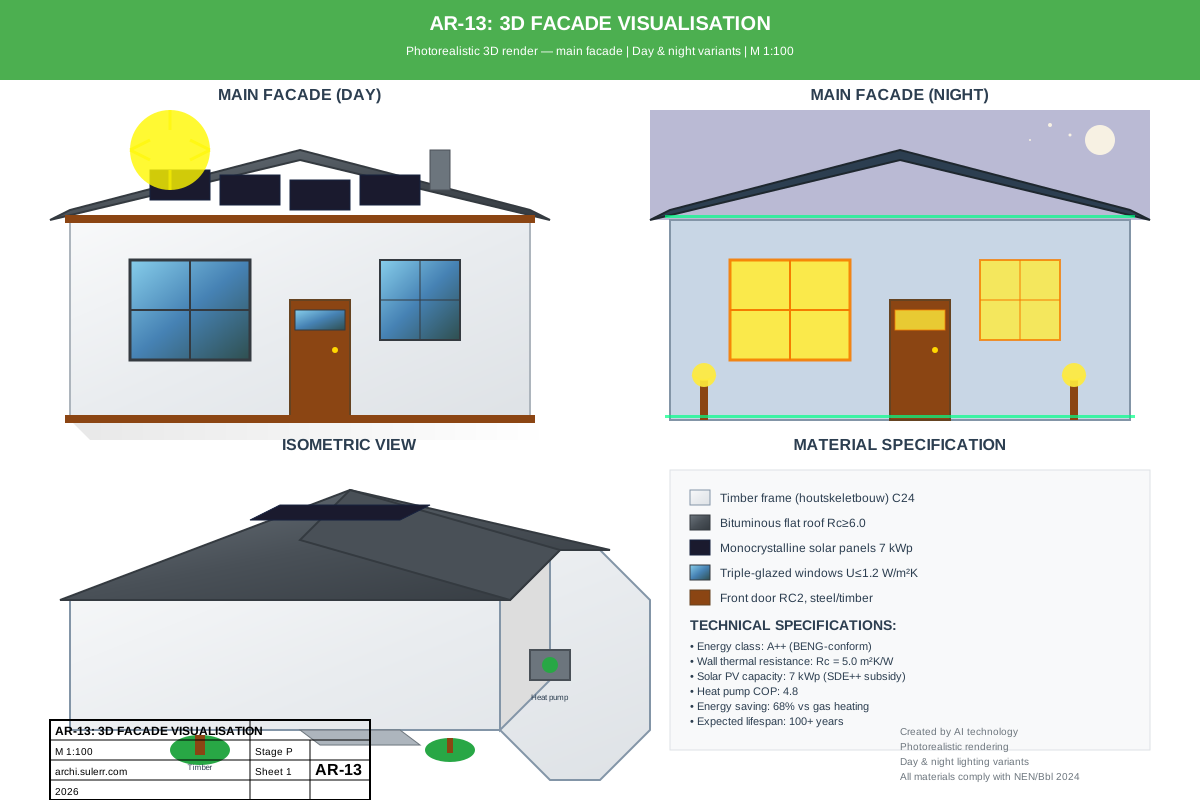
- Elevations (gevelaanzichten) on all four sides with materials and colours indicated
- Cross sections (doorsneden) — at least one transverse and one longitudinal
- Construction principle drawings (constructieprincipe) for the main load-bearing system
- BENG calculation report following NTA 8800 with summary on the cover
- MPG calculation for environmental performance of materials
- Daylight (NEN 2057) and ventilation (NEN 1087 / Bbl Afd. 3.6) verification
- Fire-safety analysis per Bbl Afdeling 3.2 (compartmentation, escape routes)
- Bouwbesluit / Bbl checklist demonstrating compliance per chapter
- Bodemonderzoek (soil investigation) NEN 5740 — frequently required before any foundation choice
Typical timeline
From a complete brief to a permit decision the realistic window for a single-family new build is four to seven months. The split between our side and the municipality's side looks like this:
Brief and feasibility
ArchitectWe assemble the brief, check the omgevingsplan, and run a vooroverleg request with the municipality if anything is uncertain. Typically 2–3 weeks.
Design and BENG iteration
ArchitectSchematic design through definitief ontwerp, with BENG-1/2/3 iteration in NTA 8800 software. 4–8 weeks depending on complexity.
Permit dossier assembly
ArchitectDrawings, calculations, soil report, energy report and Bbl checklist are bundled and signed before upload to omgevingsloket.nl. 1–2 weeks.
Welstand and municipal review
AuthorityThe municipality runs the welstand (aesthetic) check in parallel with the technical review. Regular procedure: 8 weeks; +6 weeks extension is common.
Decision and start works notice
ClientOn a positive decision the permit becomes irrevocable after a six-week objection period. The contractor files a separate melding aanvang werkzaamheden before site start.
Common pitfalls
Mistakes that we see ruin Dutch residential projects, ordered by how often they hit:
Skipping the soil investigation before the foundation choice
Large parts of the Randstad sit on soft Holocene clay and peat. Designing piles before a NEN 5740 / NEN 5740-S0 report exists almost always leads to a redesign after the soil result comes in. We ask for, or commission, the bodemonderzoek before the structural concept is locked.
Assuming the bestemmingsplan still applies
Many municipalities have already published a draft omgevingsplan with different setback and height rules than the old bestemmingsplan. We always check the most recent omgevingsplan in DSO, even when ruimtelijkeplannen.nl still shows the old document.
Underestimating BENG-3 (renewable share)
BENG-1 and BENG-2 are usually achievable through insulation and ventilation choices. BENG-3 — the minimum renewable-energy share — frequently forces the architect back to the roof plan to add PV. Catching this at concept stage saves a redesign late.
Welstand surprises on visible facades
In a beschermd stadsgezicht the welstandsnota can impose material, colour and detailing choices the client did not see coming. We screen the welstandsnota at brief stage and flag conflicts early.
Filing under the regular procedure when an exception is needed
If even one parameter (height, footprint, function) exceeds what the omgevingsplan allows, the application must run the extended procedure (26 weeks, not 8). Filing under the wrong track gets the application rejected as incomplete after the eight-week count is already gone.
Who can sign the dossier
In the Netherlands the title 'architect' is legally protected. The final dossier must be signed by an individual whose name is on the architectenregister maintained by the Stichting Bureau Architectenregister (SBA). We work with SBA-registered partner-architects per region and only release a Tier 2 permit package once that signature is committed. AI is used to draft, the engineer reviews, but the architect carries the professional responsibility.
RegisterStichting Bureau Architectenregister (SBA)
What we deliver at each tier
Our four-tier model applies equally in the Netherlands. Indicative summaries for a typical residential brief:
Tier 0 — Free concept
AI-drafted concept proposal in 30 minutes: massing, room layout, indicative BENG strategy, indicative cost band. No signature, no permit value.
Tier 1 — Pre-application
Schematic dossier suitable for a vooroverleg request: site plan, floor plans, elevations, brief Bbl narrative. Reviewed by our engineer.
Tier 2 — Permit package
Complete omgevingsvergunning dossier ready for upload to omgevingsloket.nl, signed by the SBA-registered partner-architect.
Tier 3 — Construction set
Tier 2 plus execution drawings, details, contractor-grade specifications and BENG verification.
Frequently asked questions — Netherlands
›Do I still need an omgevingsvergunning under the Omgevingswet?
Yes — for a new build, an extension that changes the building envelope, or any work that does not fit the municipal omgevingsplan. The portal changed (omgevingsloket.nl replaced omgevingsloket.online), the underlying obligation did not.
›How long does the permit take?
Regular procedure: 8 weeks plus a possible 6-week extension and a 6-week objection period. Extended procedure (when an exception is needed): 26 weeks. We design the project to fit the regular procedure whenever possible.
›What is BENG and does it apply to renovations?
BENG sets three caps — energy demand, primary fossil-energy use, and renewable share — calculated per NTA 8800. It applies in full to new homes from 2021 onwards. Major renovations follow a lighter regime (typically Rc-values per Bbl and a fixed renewable share) rather than the full BENG calculation.
›Can you work on a monument or in a protected townscape?
Yes, but the timeline is longer. A monument needs an additional omgevingsvergunning voor de activiteit wijzigen of slopen van een rijksmonument, and the welstandsnota in a beschermd stadsgezicht typically imposes detailed material and colour choices. We screen this at brief stage.
›Why must an SBA-registered architect sign?
Dutch law protects the title 'architect'. Only individuals on the SBA register may use the title and assume the professional responsibility for a building dossier. Our AI drafts, our engineer reviews, and the SBA-registered partner-architect signs — none of these steps is optional.
Portfolio
Ready to start your Dutch residential brief?
Answer the brief calculator and we will return a free Tier 0 concept proposal within 30 minutes, with a clear path to a signed omgevingsvergunning dossier.