Residential project documentation for Germany
From a free concept proposal to a full Bauantrag dossier — prepared with AI, reviewed by an engineer, signed by an architect entered in the Architektenkammer of the relevant Bundesland.
Germany · DE
Regulatory framework
German residential construction sits inside a two-level system: federal Bauplanungsrecht (the Baugesetzbuch, BauGB) regulates land use, and Bauordnungsrecht — the Landesbauordnung (LBO) — regulates the construction itself. There is one BauGB, but sixteen different LBOs: Bavaria's BayBO, North Rhine-Westphalia's BauO NRW, Berlin's BauOBln and so on. The procedure, distances to neighbours, fire-safety thresholds and even the documents required vary from Bundesland to Bundesland, and the local Bauamt is always the final arbiter.
Under the BauGB, what you may build on a plot depends on whether the plot lies in the area of a qualifizierter Bebauungsplan (§ 30 BauGB), inside the unplanned inner area (§ 34 BauGB, where the project must einfügen with its surroundings), or outside (§ 35 BauGB, restricted to privileged uses). The first step on any brief is therefore to read the relevant Bebauungsplan or to assess § 34 compatibility — sometimes via a written Bauvoranfrage to fix specific questions before the Bauantrag.
The standard permit application is the Bauantrag. Many LBOs offer a vereinfachtes Baugenehmigungsverfahren for single-family houses, where the Bauamt no longer checks the full Bauordnungsrecht and the architect (Entwurfsverfasser) carries broader responsibility for compliance. Some Länder also offer Genehmigungsfreistellung for plots covered by a qualifizierter Bebauungsplan with no conflicts — fast, but the planning compliance is on the architect.
Energy performance is governed by the Gebäudeenergiegesetz (GEG), which since 1 November 2020 has consolidated the EnEG, EnEV and EEWärmeG. For new dwellings the GEG sets caps on primary energy demand and the building envelope, plus a renewable-heat share. Calculations follow DIN V 18599 for non-residential and DIN V 18599 or the simplified DIN V 4108-6 / DIN V 4701-10 route for residential buildings; an Energieausweis must be issued on completion.
Procedurally a full Bauantrag is decided in roughly two to four months, varying widely by Land and Bauamt workload. The vereinfachtes Verfahren is often faster. Fees follow the Land's Verwaltungskostengesetz and scale with construction cost. Note that this overview describes general rules — the binding details for any given project are those of the relevant Land's LBO and the local Bauamt.
Typical scope of works
For a German residential Bauantrag the documentation package we prepare typically covers, subject to the relevant Landesbauordnung:
- Lageplan (site plan), often required as amtlicher Lageplan stamped by a public surveyor (öffentlich bestellter Vermessungsingenieur)
- Bauzeichnungen at 1:100: Grundrisse, Schnitte, Ansichten for every level
- Baubeschreibung following the Land's template form
- Statistische Angaben zum Bauvorhaben (Wohnflächenberechnung after WoFlV, Brutto- and Nettogrundfläche per DIN 277, Brutto-Rauminhalt)
- Standsicherheitsnachweis (structural verification) signed by a qualified Tragwerksplaner
- Brandschutznachweis per the LBO — typically self-certified for GK1/GK2 single-family houses
- GEG verification: primary-energy demand, envelope U-values and renewable-share calculation per DIN V 18599
- Schallschutznachweis per DIN 4109
- Wärmebrückennachweis (thermal-bridge verification) per DIN 4108 Beiblatt 2 where claimed
- Entwässerungsplan and proof of connections to public networks where required
- Statement of the relevant Bebauungsplan or § 34 BauGB compatibility
Typical timeline
From a complete brief to a Baugenehmigung the realistic window for a single-family house in Germany is four to seven months. The split varies by Land:
Brief, Bebauungsplan check, optional Bauvoranfrage
AuthorityWe pull the Bebauungsplan or assess § 34. For non-trivial questions a Bauvoranfrage is filed to fix the planning answer in writing. 2–6 weeks depending on Bauamt response.
Entwurfsplanung (LPH 3 HOAI)
ArchitectSchematic and detailed design inside the planning envelope. 4–8 weeks.
Genehmigungsplanung (LPH 4 HOAI)
ArchitectBauantrag pack: Bauzeichnungen, Baubeschreibung, statics, Brandschutz, GEG, Schallschutz, Lageplan. 3–5 weeks.
Bauamt review
AuthorityThe Bauamt decides on the Bauantrag — typical range 6–16 weeks depending on Land and complexity. The vereinfachtes Verfahren is faster but still requires a decision.
Roter Punkt and start of works
ClientOn a positive decision the Roter Punkt / Baufreigabe is issued and works can start. A Bauleiter is appointed; the Bauamt may carry out inspections at defined milestones.
Common pitfalls
Failure patterns we see most often on German residential briefs:
Treating one LBO as if it applied everywhere
Distances to neighbours (Abstandsflächen), garage rules, balcony projections — all of these vary by Bundesland. Copying a Bavarian solution to NRW (or vice versa) regularly trips the first Bauamt review. We always check the specific LBO before locking the massing.
Ignoring § 34 BauGB einfügen on unplanned plots
On plots without a qualifizierter Bebauungsplan, the project must einfügen — fit into the surrounding context. A modern cube next to a row of 1960s gabled houses can be refused on planning grounds even when every dimension is allowed. We screen § 34 context early.
GEG miscalculation on the renewable share
GEG mandates a minimum share of renewable energy for heat. Choosing a gas Brennwert system without a compensating heat pump or PV-thermal can fail the GEG even when the U-values are excellent. We iterate the GEG calculation before locking the heating choice.
Forgetting that the Lageplan must be amtlich
Many Bauämter require a stamped Lageplan from a public surveyor (öffentlich bestellter Vermessungsingenieur), not a CAD plan drawn from a kataster export. Discovering this at submission costs two to four weeks.
Filing under Genehmigungsfreistellung when a Befreiung is needed
Genehmigungsfreistellung is only available when the project complies fully with the Bebauungsplan. Any Befreiung (exemption) triggers the full Bauantrag — filing under the freistellung route when an exception is needed costs a restart.
Who can sign the dossier
In Germany the right to sign as Entwurfsverfasser for a building application is reserved for individuals on the Architektenliste of one of the sixteen Architektenkammern. Membership is by Land — the architect can sign in the Land where the Kammer admits them. The Standsicherheitsnachweis must be signed separately by a qualified Tragwerksplaner. We work with Architektenkammer-registered partner-architects per region; AI drafts, the engineer reviews, the Architektenkammer architect signs and carries the professional responsibility.
RegisterArchitektenkammer (per Bundesland)
What we deliver at each tier
Our four-tier model maps to the German procedure as follows:
Tier 0 — Free concept
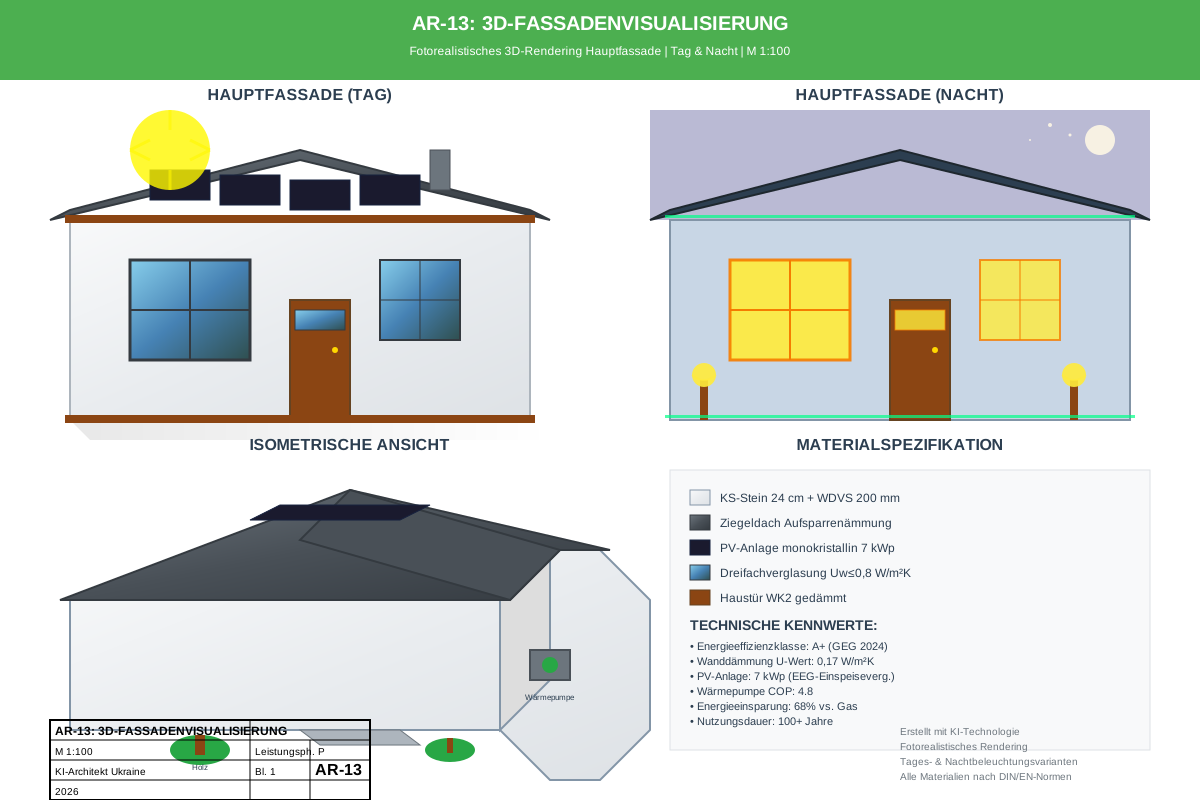
AI-drafted concept in 30 minutes: massing, plans, indicative GEG strategy, indicative cost band. No signature, no permit value.
Tier 1 — Pre-application
Schematic dossier suitable for a Bauvoranfrage: plans, facades, Baubeschreibung-style narrative. Engineer-reviewed.
Tier 2 — Permit package
Complete Bauantrag dossier ready for the Bauamt, signed by the Architektenkammer-registered partner-architect.
Tier 3 — Construction set
Tier 2 plus Ausführungsplanung (LPH 5 HOAI), Detailplanung and coordination with Tragwerksplaner and TGA.
Frequently asked questions — Germany
›Which Landesbauordnung applies to my project?
Whichever Bundesland the plot is in. The sixteen LBOs differ on distances, fire-safety thresholds and procedural choices. We confirm the LBO and the local Bauamt's practice at brief stage and design strictly against them.
›What is the GEG and what does it require?
The Gebäudeenergiegesetz consolidates Germany's earlier energy laws. For new dwellings it caps primary-energy demand, sets envelope minimums and requires a renewable-heat share. The calculation typically follows DIN V 18599 and the result is documented in the Energieausweis.
›What is a Bauvoranfrage and when should I file one?
A Bauvoranfrage asks the Bauamt to fix a specific planning question in writing — e.g. 'Is a 9 m ridge height allowed here?' — before the full Bauantrag is prepared. It is highly useful for § 34 plots or where the Bebauungsplan leaves room for interpretation.
›When can I use Genehmigungsfreistellung instead of a full Bauantrag?
Some LBOs allow Genehmigungsfreistellung for plots inside a qualifizierter Bebauungsplan with no Befreiung needed. It is faster but moves more responsibility onto the architect, and any deviation from the Bebauungsplan automatically reinstates the Bauantrag route.
›Why must an Architektenkammer-registered architect sign?
German law restricts the right to sign as Entwurfsverfasser to individuals on the Architektenliste of the relevant Architektenkammer. Our AI drafts, our engineer reviews, and the Kammer-registered partner-architect signs.
Portfolio
Ready to start your German residential brief?
Answer the brief calculator and we will return a free Tier 0 concept proposal within 30 minutes, with a clear path to a Bauantrag in the relevant Bundesland.